
In my experience, I’ve seen two very different kinds of contractors hired for remodeling work.
One was an established company with years in business, insurance, licensing, reviews, references, contracts, and all the things you normally associate with an established business. The other was much more informal—a personal phone number, no real business presence, very little history to research, and a referral from someone they knew.
There are also contractors who fall somewhere in between—the smaller mom-and-pop businesses that may not have 25 years in business yet, a website, or all the things we normally associate with a long-established company. I just don’t have much personal experience with contractors in this group.
This does not mean every small or newer contractor is a bad choice, or that every established company is a good one. What I have seen are two remodeling experiences that were almost complete opposites, and they taught me a lot about what I would look for before handing someone a large amount of money to work on my home.
I would use the same basic process for any contractor: gather information, check insurance and licensing, look at references and past work, get the bid in writing, pay attention to communication, and compare everything together.
I have two different people in my family who have hired contractors for remodeling work on their homes. These situations were like night and day. I learned so much from their experiences and from watching what they went through that I wanted to share a little about their stories before talking about some things to consider when hiring a contractor.
The Bad Experience
The bad experience started with a friend’s referral for a contractor and no contract. The contractor said he was just starting out, offered a very reasonable price, and could start work right away. He asked for half of the total price as a down payment, with the rest due upon completion. He was paid and began work that day. He worked that day and never came back.
They went with another friend’s referral, and it wasn’t much better. This contractor fixed what the first guy messed up, did a little more work, and then never came back to finish.
It is easy to look at something like this afterward and say, “Well, you should have known better.”
But the truth is that when your home isn’t functioning, money is tight, and you are stressed with a dozen different things happening at once, choices that seem reasonable in the moment can look very different later.
Their house had flooded and they were displaced. This wasn’t somebody casually deciding to remodel a bathroom because they were tired of the tile. They were trying to get their home functioning again, spending large amounts of money on many projects at the same time, living off-site, and dealing with the loss of almost everything they owned.
A Completely Different Experience
The good experience happened under very different circumstances.
They had purchased a house to remodel after selling their previous home. They had a clear budget and planned to move into the house while the work was being completed.
For each job, they collected at least three bids.
They read Google reviews—especially the bad ones. They researched how long the companies had been in business. They asked for pictures, references, and contracts.
They also had the contractors come to the house whenever possible to see the work, take measurements, and discuss the scope in person.
The contractors were compared on more than price. They looked at reviews, insurance, licensing, contracts, references, communication, and whether the contractor seemed to clearly understand the work they wanted done.
They did not have any bad experiences with the contractors they hired, even when change orders became part of the projects.
What I Would Tell My Own Friends and Family
Based on what I have watched happen, I would tell my own friends and family to get at least three quotes, but compare more than just price.
You want someone who communicates well, acts professionally, carries appropriate insurance, meets any licensing requirements, has good reviews and/or solid references, and clearly understands the scope of the job.
Meet them in person when you can.
Get the bids in writing so you can sit down later, without someone standing in front of you waiting for an answer, and actually compare them.
Take the time you need to understand as much as possible about the person or company you are about to trust with your home and your money.
What I Would Compare Before Hiring a Contractor
Scope of Work
Whenever possible, have the contractor come out and actually look at the work that needs to be done.
They can see the area, take measurements, look at damage, ask questions, and make sure they understand what you are expecting.
A phone conversation can only explain so much.
Having both of you standing in the same place looking at the same project gives you a much better chance of being on the same page before work starts.
Total Price—and What That Price Actually Includes
A quoted price doesn’t mean much if you don’t understand what is included in it.
Ask about the breakdown between labor and materials and what is specifically included or excluded.
Say you need three new exterior doors and receive a price for the job.
You might naturally assume that price includes hanging the doors.
It may not.
Now imagine one contractor’s bid is $1,000 lower than another one, but the lower bid doesn’t include installation.
Suddenly the “cheaper” contractor may not actually be cheaper.
This is why comparing the total cost and scope together matters much more than simply choosing the lowest number.
Deposit & Payment Terms
Know what the deposit will be before you agree to anything.
Also understand how and when the remainder will be paid.
Will there be progress payments? Is the final payment due when the work is complete? Are materials paid separately? Does the payment method affect the price?
Different contractors may structure payments differently, and those differences can matter to your budget even when their total quotes are similar.
Start Date & Timeline
Start dates can matter just as much as price.
If your air conditioner goes out in the middle of a Texas summer, a contractor who can start six weeks from now may not be much help.
A new backsplash is a different story.
There may also be times when you are willing to wait longer for the contractor you really want, or pay more because getting the job completed sooner matters more to you.
There is no one right answer.
It depends on the job and what matters most in your situation.
I would also treat completion timelines as estimates. Renovations have a way of uncovering things nobody expected, and outdoor work can be delayed by weather and other circumstances outside anyone’s control.
Quote Expiration
This is an easy one to overlook.
Contractor bids have shelf lives too.
If you receive a quote that you are seriously considering, find out how long that price is valid and keep track of the expiration date.
Material prices change, schedules fill up, and many contractors will not guarantee the same bid indefinitely.
The last thing you want is to finally make your decision only to discover that the quote you chose is no longer valid.
Insurance & Licensing
Some professions require state or local licensing, so check with your state or local government to know what you should be asking for.
Insurance/bonding is another area you should research when hiring contractors so you know if this is something that you would feel more comfortable with them having.
Insurance or bonding does not guarantee that you will have a good experience.
Nothing does.
But for work involving things such as electrical, plumbing, or HVAC, I would personally feel much more comfortable knowing I had checked the licensing requirements and verified whatever credentials applied to that work.
References, Reviews & Photos
Think of these as more tools in your tool chest.
Google reviews, personal references, and pictures of previous work can all help you build a clearer picture of who you are hiring.
A company can have overwhelmingly good reviews and still have a few unhappy customers. Those complaints may tell you about possible problems—and then you can decide whether those particular problems matter to your project.
One bad review doesn’t automatically make someone a bad contractor any more than one glowing review makes someone a great one.
Warranty
Ask whether the contractor warranties their work, and get the warranty information in writing.
If you are hiring through a flooring, cabinet, window, or other finishing store, ask separately about the warranty on the product and the warranty on the installation.
Know how long the warranty lasts, what it covers, and what you need to do if you ever have to use it.
Then put the paperwork somewhere you will actually be able to find it later.
Having a warranty but not knowing where it is, when it expires, or how to make a claim isn’t very helpful.
Communication
Communication can come from everywhere now—emails, texts, phone calls, handwritten notes, printed contracts, invoices, and sometimes a combination of all of them.
Ask the contractor what form of communication works best for them and tell them what works best for you.
Then keep those records together.
Even a simple folder for the project is better than trying to remember six months later whether an important detail was in a text message, an email, or written on the back of a piece of paper.
Those records may also be useful later if you sell your home or need repairs.
How Changes Will Be Handled
Changes happen.
Maybe you decide you want a larger shower and the price goes up.
Maybe they remove the old shower and discover rot and a lack of greenboard where it should have been.
Maybe you get lucky and the tile you wanted goes on sale and the price goes down.
Changes can come from you, the contractor, or something nobody knew existed until the project was opened up.
Before work begins, I would like to know how those changes will be documented, priced, approved, and added to the project.
Having a plan for change orders can help you stay on top of the budget, reduce communication problems, and understand what is happening with your project.
How do you compare it all?
You may have three completely different bids sitting in front of you. One includes materials. Another doesn’t. One requires a large deposit. Another has better payment terms. One can start next week. Another is booked for six weeks. One offers a warranty. Another doesn’t.
Now you are trying to compare scope of work, price, what is and isn’t included, deposits, payment arrangements, start dates, quote expiration dates, insurance, licensing, reviews, references, pictures, warranties, change orders, and communication.
That is a lot of information tied to a very expensive decision.
The Bottom Line
There is no single question you can ask that guarantees you will hire the perfect contractor.
But gathering good information, comparing it carefully, and keeping it organized can help reduce some of the risk.
Good decisions start with good information.
Take the time to gather it. Organize it. Ask questions. Read the reviews. Compare the bids. Follow your gut.
And don’t blindly hand someone a big chunk of your hard-earned money because their price was the lowest, they could start tomorrow, or somebody told you their friend’s friend has a son who can replace your roof.
That may work out perfectly.
But I would want a little more information first.
If You Have Several Contractor Bids to Compare
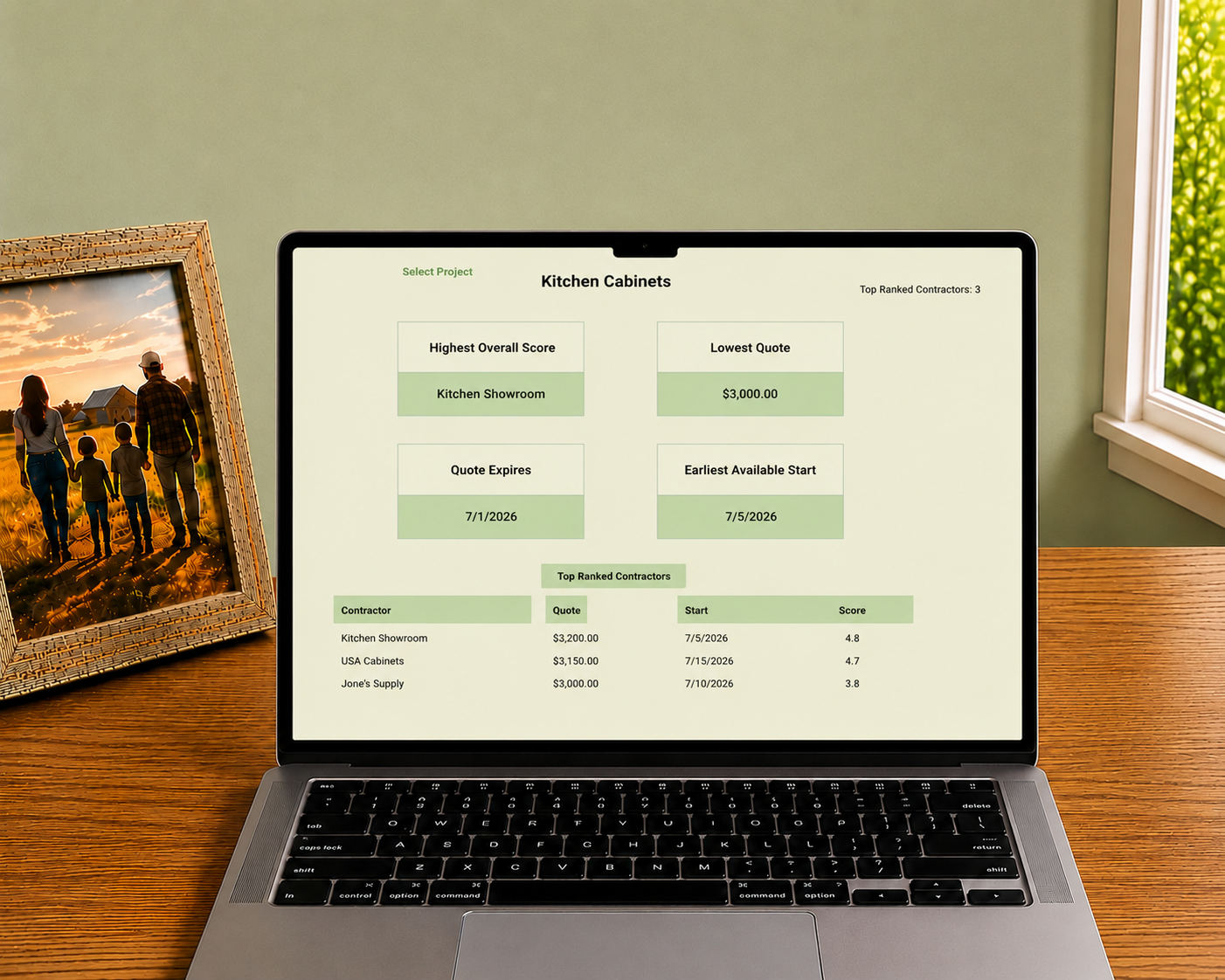
This exact problem—trying to compare prices, scope, payment terms, start dates, warranties, references, and everything else sitting in a pile in front of you—is why I created the Contractor Bid Comparison Tracker.
It gives you one place to put the information from each bid so you can compare the contractors side by side instead of trying to keep all of those details straight in your head.